
My Personal Journey: Understanding My Child
I didn’t start searching for information about the signs of dyslexia in children by age because I wanted to write about it. Instead, I started because I was a mother trying to understand my own child.
Some things came to him easily. Others, especially certain letters, sounds and early reading skills, felt like pushing a boulder uphill. However, the moments that confused me most were when he would get something right, only for it to seem completely unfamiliar a few days later.
For example, we would learn a set of three-letter words on Monday, but by Wednesday they all felt brand new to him. It wasn’t that he wasn’t trying. At six, he had finished learning the lowercase alphabet, yet he still wrote b, d, c, s and g as mirror images.
Of course, letter reversals on their own aren’t a reason to assume a child has dyslexia, because many young children mix up letters while learning to write. However, what stood out for us was the bigger picture: the forgetting, the sounds that wouldn’t stick and the continued difficulty with early reading skills.
Naturally, I began asking myself the questions so many parents ask: Is this normal learning? Does he just need more practice? Am I expecting too much, or is there something I’m missing?
Searching for Answers and Finding Clarity
With these questions in mind, I started looking for answers. However, I found almost too much information. Some articles made every small slip sound like a warning sign, while others simply advised parents to “wait and see.” What I struggled to find was clear guidance on how to tell the difference and when it was time to stop waiting and ask for help.
Eventually, my son was identified as having dyslexia by a doctor. I’m a doctor myself, a consultant anaesthetist with 16 years in medicine, but I’ll be honest: knowing medicine did not make this any easier. When it’s your own child, you’re a parent first.
Most importantly, the diagnosis changed how I saw him. Rather than focusing only on the things he found difficult, I started asking what support he needed, how he learned best and how I could help without adding pressure.
This guide brings together what I wish someone had explained to me at the beginning. It explores dyslexia symptoms in children at different ages, what may be part of typical development and what deserves a closer look, how dyslexia is diagnosed, and the steps parents can take next. Above all, the aim isn’t to label a child, but to understand their struggles early enough to find the right support.
A quick note: I’m sharing my experience as a mother alongside general information. I’m not a dyslexia specialist, and this article doesn’t replace a professional assessment.
What Is Dyslexia? A Simple Explanation for Parents
Dyslexia is a learning difference that affects how the brain connects letters to sounds. It makes reading, spelling and sometimes writing harder, even for a child who is bright, curious and working hard.
Three things I wish more parents knew:
- It is not a sign of low intelligence. Many dyslexic children are sharp thinkers, creative and great talkers.
- It is not laziness or poor parenting. No amount of “try harder” fixes a difference in how the brain processes sounds.
- It isn’t really about seeing letters backwards. Lots of young children reverse letters while learning to write. The core difficulty is linking sounds to symbols quickly and automatically.
Dyslexia is common. It’s often estimated to affect around 5 to 10 percent of people, with some sources suggesting higher, and it tends to run in families. If you or your partner struggled with reading or spelling at school, it’s worth mentioning when you speak to your child’s teacher.
Early Signs of Dyslexia in Children by Age
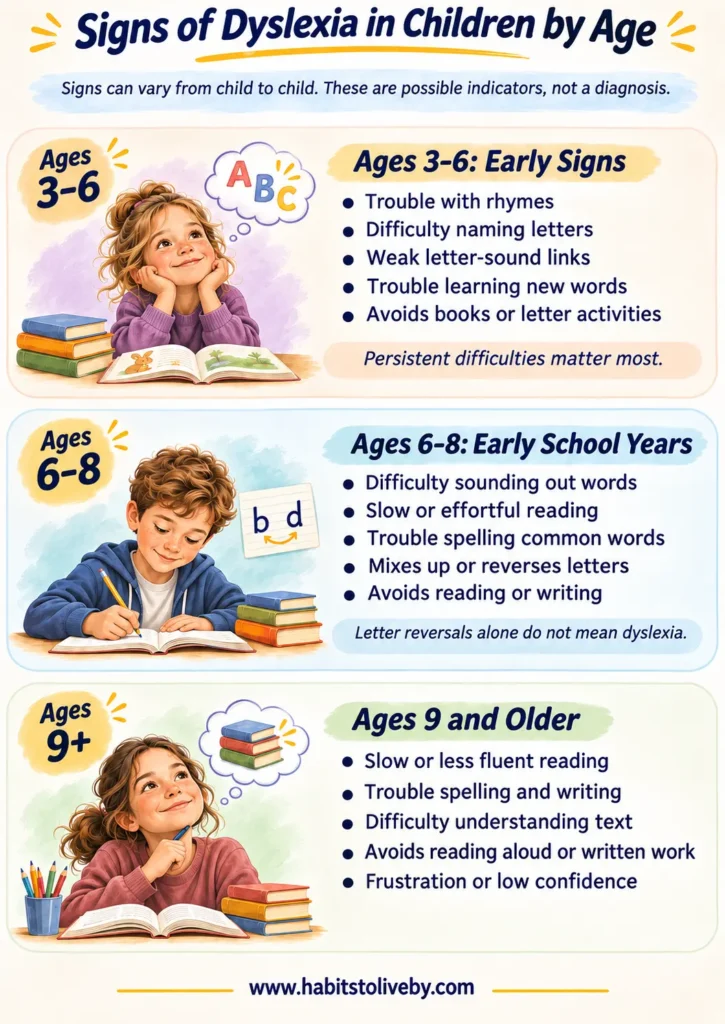
Every child learns at their own pace, and one sign on its own does not mean dyslexia. What matters is a pattern that continues despite good teaching and plenty of practice. Here is what to look for, age by age.
Preschool and Kindergarten (Ages 3 to 6)
This is the stage where dyslexia is easiest to miss, because nobody expects a small child to read yet. The clues are in speech and sound.
- Late talking, or trouble pronouncing longer words
- Difficulty learning nursery rhymes or spotting words that rhyme
- Trouble learning letter names and the sounds they make
- Mixing up similar-sounding words
- Difficulty remembering sequences, like the days of the week
- A parent or sibling who struggled with reading
In our house, it was the letters and sounds that stood out, and the way something could be right one day and gone the next. Words he’d learned on Monday were gone by Wednesday, and even after he finished the small alphabet, letters like b, d, c, s and g kept coming out as mirror images.
Ages 6 to 8
Once formal reading lessons begin, the gap often becomes visible.
- Slow, effortful reading, or guessing words from the first letter or the picture
- Difficulty sounding out new words
- Spelling the same word in different ways on the same page
- Avoiding reading aloud, or going quiet when it’s their turn
- Letter reversals that continue past the expected age
- Reading a word correctly on one page and missing it on the next
Ages 9 and Up
By now many children have found clever ways to hide the struggle.
- Reading well below what you’d expect from how clever they are in conversation
- Poor spelling and difficulty with long or unfamiliar words
- Dreading homework, and tiring quickly when reading
- Strong spoken answers but much weaker written work
- Comments like “I’m just stupid”
Signs That Don’t Look Like Reading Problems
Sometimes the first clues are emotional. Stomach aches before school, acting out to avoid reading, becoming the class clown, or a sudden drop in confidence can all be a child’s way of protecting themselves. Children often hide a struggle long before they can explain it.
Free download: Signs of Dyslexia in Children: A Parent’s Checklist by Age, a simple way to organise what you’re noticing before you talk to a teacher or doctor. Download the free checklist
Dyslexia or Just a Slow Start? When to Ask for Help
Some children simply need more time, and that’s fine. But consider asking for an assessment if:
- Difficulties continue after a term or two of good teaching
- Several signs from the lists above appear together
- There’s a family history of dyslexia or reading difficulties
- Your child’s confidence is starting to suffer
Waiting rarely helps, and early support makes a real difference. An assessment doesn’t label your child. It tells you how they learn.
How Is Dyslexia Diagnosed in Children?
There is no single blood test or scan for dyslexia. Diagnosis comes from a detailed assessment of how your child reads, spells and processes sounds.
Who Can Assess Your Child
Depending on where you live, this may be an educational psychologist, a specialist teacher with assessment qualifications, a paediatrician or a child development team. In our case, my son was identified by a doctor, after I’d spent a long while watching, noting and questioning what I was seeing.
A tip from our experience: before any appointment, write down real examples of what you notice, such as which words he lost from one day to the next and which letters he reverses. Specific examples make the conversation far more useful.
What the Assessment Looks At
- Reading accuracy, speed and understanding
- Spelling and writing
- Phonological skills, meaning how well your child hears and plays with the sounds in words
- Memory and processing speed
- A general ability check, to see the gap between potential and reading performance
- A conversation with you about development and family history
What to Ask For
Ask for a written report that names the specific areas of difficulty and recommends support. Schools often need this document to arrange help.
Where to Start
Start by discussing your concerns with your child’s teacher, who can share observations about their learning and classroom progress. Next, speak with your family doctor or the school’s learning-support team about possible assessment options. Since costs and waiting times can vary widely depending on your location, it’s also important to explore the services available in your area.
What Helped My Son (and Our Family) Most
Dyslexia support for kids works best when it’s consistent, calm and built into everyday life. These are the things that have helped in our home. Every child is different, so take what fits yours.
Structured, Phonics-Based Reading Support
Children with dyslexia usually do best with explicit, step-by-step teaching of how letters and sounds connect, rather than being left to pick it up. Ask your child’s teacher or assessor which approach they recommend for your child.
Working With the School
Go in with the assessment report and a short list of requests, such as extra time, reading support or a seat near the teacher.
Small Daily Habits at Home
We practice for around 10 to 20 minutes at a time, followed by a break. Short, regular practice protects both progress and mood. Here is what that looks like for us:
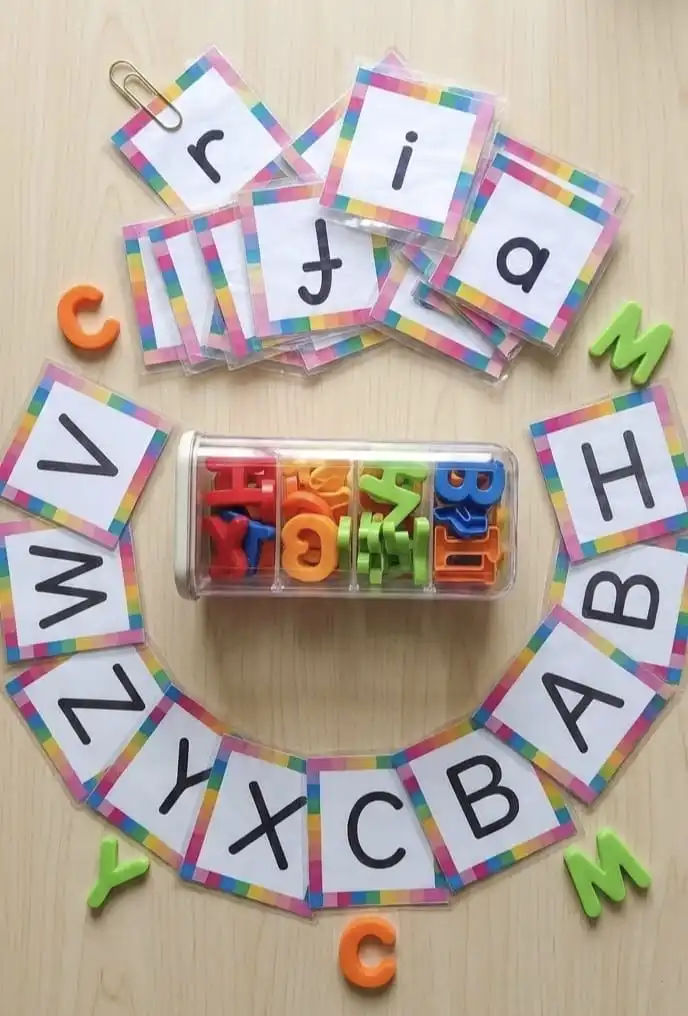
- Colourful alphabet flashcards. I began with small, colourful lowercase cards. Once he was more familiar with them, I introduced larger flashcards.
- Different pencils and stationery. A new pencil or a different pen can make writing feel more inviting.
- A gentle approach. I encourage effort rather than expecting perfection, and we stop before frustration builds.
If you’d like ready-made practice material, I create printable resources for exactly this at Smart Sprouts. Browse the Smart Sprouts printables
Tools That Made Homework Easier
Reading support: In addition to traditional reading practice, audiobooks and text-to-speech tools can help children access stories and written content in different ways. Furthermore, choosing books with clear fonts, larger spacing and uncluttered pages may make reading feel less overwhelming. I’ll share some useful recommendations here as well.
Protecting His Confidence
Praise effort, not just results, and make room for the things he’s good at. Learning is a long road, and a child who feels safe to try is a child who keeps trying.
Make practice easier: Colourful, printable learning resources for early readers from Smart Sprouts. Browse the printables
What to Say (and Not Say) to a Child With Dyslexia
The words we use become the voice in their head. A few that help:
- “Reading is harder for your brain, and it’s not your fault.”
- “I’m proud of how hard you tried.”
- “We’re going to work on this together.”
And a few to avoid:
- “Just try harder.”
- “Why can’t you get this? Your brother does.”
- “You’re not paying attention.”
Helpful Resources for Parents
Finding the right information and resources can make supporting your child feel a little easier. Here are a few places to explore:
- Learn about dyslexia: The International Dyslexia Association, British Dyslexia Association and NHS offer reliable information about dyslexia, its signs and support.
- Learning resources: Visit Smart Sprouts for printable activities and educational resources designed to support children’s early learning and practice at home.
- Writing and stationery: To make writing practice more comfortable and enjoyable, try simple items such as chunky pencils, pencil grips, colourful notebooks and erasable markers. Additionally, choosing stationery your child enjoys using can make practice feel less like a task and more like a fun activity. I’ll also share some useful product recommendations here.
- Reading support: Audiobooks, beginner-friendly books and reading tools can offer children different ways to engage with stories and language. The right choice will depend on your child’s age and learning needs.
- More helpful ideas: Keep exploring the blog for practical guidance, activities and resources to support your child’s learning journey.
Common Myths About Dyslexia
- “They’ll grow out of it.” Dyslexia is lifelong, though the right support makes reading far easier.
- “It’s about seeing letters backwards.” It’s mainly a difference in how the brain processes the sounds in words.
- “Dyslexic children can’t succeed.” Many are creative, strong problem-solvers and go on to thrive as adults.
- “It means they’re not smart.” Intelligence and dyslexia are unrelated.
Famous People With Dyslexia
When a child is struggling, it helps to see what is possible. Many well-known people have spoken publicly about living with dyslexia:
- Richard Branson, entrepreneur and founder of the Virgin Group, has talked openly about his dyslexia and how it shaped the way he works.
- Steven Spielberg, the film director, shared that he was diagnosed as an adult after years of difficulty at school.
- Whoopi Goldberg, actor and comedian, has spoken about her dyslexia and the stigma she felt growing up.
- Jamie Oliver, chef and author, has described struggling with reading at school before finding his strengths in cooking.
- Keira Knightley, actor, has said that her dyslexia was identified in childhood and that her parents’ support made a difference.
- Henry Winkler, actor and author, was not diagnosed until adulthood and now writes children’s books inspired by his experience.
These stories don’t make the struggle any less real. What they show is that dyslexia says nothing about a child’s intelligence, creativity or future, and that the right support makes a real difference.

Frequently Asked Questions About Dyslexia in Children
Can a child have dyslexia and still read well?
Yes. Some children compensate with strong memory or intelligence, but reading is often slow, tiring or inaccurate with unfamiliar words, and spelling usually lags behind.
Is dyslexia hereditary?
It often runs in families, so a parent or sibling with reading difficulties raises the likelihood.
Can dyslexia be cured?
No, but with targeted teaching and support, children can become confident, capable readers.
At what age can dyslexia be diagnosed?
Risk signs can appear in preschool. Formal diagnosis is usually possible once a child has had some formal reading instruction, often around age 6 to 7, though this varies by country.
Does dyslexia go away with age?
No, but strategies and support make daily life much easier.
Final Thoughts: You’re Not Behind, and Neither Is Your Child
I think back to those early evenings when I couldn’t understand why something he’d known yesterday had slipped away. I thought something was wrong, with him or with me. What I know now is that he needed a different path to the same place.
If you’re reading this because something feels off, trust that instinct. Talk to your child’s teacher, ask for an assessment, and start early. You’re not overreacting, and you’re not alone.
Want the free checklist? Download Signs of Dyslexia in Children: A Parent’s Checklist by Age and share this article with another parent who might need it.
Disclosure: some links on this site may be affiliate links. I only recommend tools and resources I’d use myself.